|
|
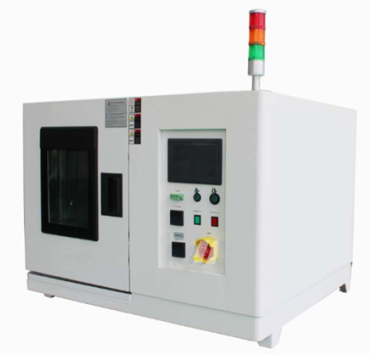
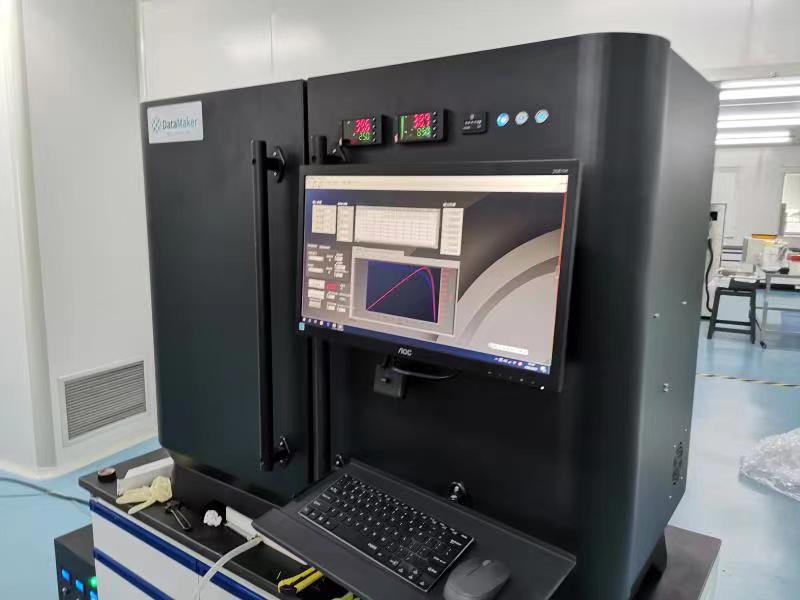
Perovskite battery cyclic exposure testing system

Collect
The perovskite cell cyclic exposure testing system can simulate damage caused by full-spectrum sunlight, temperature and humidity changes, and can replicate outdoor aging effects for months or even years within days or weeks. It can provide corresponding environmental simulations and accelerated testing for scientific research, product development, and quality control.
Product Features and Advantages: 1. A very simple user interface for quick results 2. Uses a unique light intensity feedback system with excellent light intensity stability (within ±2%), with a temperature range of 20 to 90°C 3. Temperature accuracy can be within the ±1°C range, and between 20 and 90°C. ± 0.5°C ranges from 25 to 60°C. 4. The constant temperature chamber is equipped with a BNC connector for constant temperature I-V measurement 5. The observation window allows you to observe samples in a temperature-controlled room without opening the door. 6. Capable of dual 85 testing, 85% humidity, and 85°C long-term aging tests. 7. Capable of long-term testing for 15,000 hours without the need to replace the lamp source 8. The bottom of the aging chamber chamber uses a drainage groove design to prevent steam condensation and maximize protection of the test workpiece. Product specifications: 1. Configuration (1) Light source section (2) Optical system (3) Constant temperature chamber (4) Measurement system
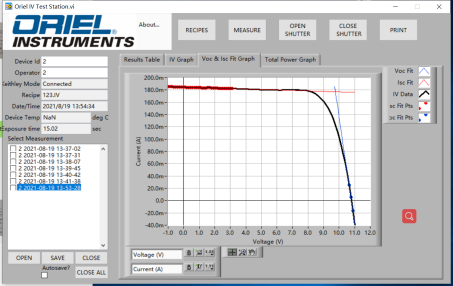
(IV Curve Chart)
2. Specifications (1) Light source section (1) Use a 200W high-brightness LED light source. (2) Dual cooling systems using adjustable fans for air cooling and water cooling. (3) The system is equipped with a safe, adjustable DC power supply. (4) The power supply uses a constant lighting LED source, offering a long lifespan and stable light intensity.
(2) Optical system (1) Multiple LED beads, uniform illumination area intensity. (2) The illuminated area should be 300 mm × 300 mm. (3) The focal length at the outlet of the exit concentrator system should be at least 110-220mm. (4) The optical axis height should be 50-140mm.
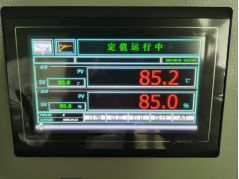
(Double 85 Test)
(3) Constant temperature chamber (1) Set the temperature range from 20 to 90°C. (2) Temperature accuracy should be within the range of ±1°C and between 20 and 90°C. ± within the 0.5°C range The temperature range is 25 to 60°C. (3) Temperature settings should be controlled via digital microcomputer PID. (4) The temperature sensor should use a K-type thermocouple. (5) The humidity measurement range should be from 0 to 85% RH. (6) Humidity measurement accuracy should be ±2% (25°C, 0 to 80% RH). (7) BNC connector panels are built into a temperature-controlled chamber. (8) The observation window allows observation of the sample temperature chamber without opening the door. (9) Sample racks/brackets should be included as standard configuration.
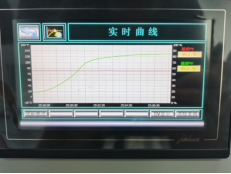
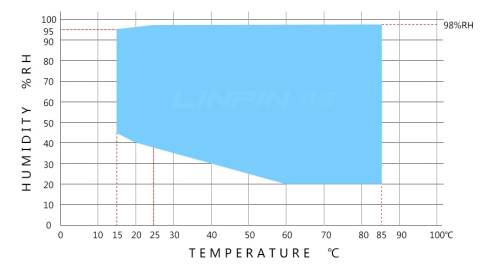
(Temperature and humidity controllable range diagram, no active humidity or thermal load)
(4) Measurement system (1) Equipped with a relay box with 16 sample switching, capable of switching 16 samples. (2) In the four sample switching relay boxes, when no sample is measured, three types of open-circuit, short-circuit, or load resistors can be selected for each sample. (3) For each of the 16 samples, the load resistance of the switch relay box for 4 samples should be able to continuously vary from 0 to 2000Ω. (4) Ammeters and voltmeters should be installed, with a current measurement range of ±10 pA to 1 A or higher, and a voltage application range of ± 1μV to 20 V or higher. (5) Time process I-V measurement software should be provided. Up to 1000 hours (60,000 minutes), with a minimum step of 1 minute, can arbitrarily input IV and short-circuit current measurements. (6) The sample names and sample regions of the 16 samples can be entered separately in the time process I-V measurement software. (7) I-V measurement software should be able to measure short-circuit current density, open-circuit voltage, maximum output, maximum supply voltage, maximum power current, fill factor (FF), conversion efficiency, series resistance, parallel resistance, and the preset time interval. (8) Time process I-V measurement software can save measurement data in text in real time during time process measurements and can create an Excel file after measurement completion. (9) The schedule I-V measurement software should be in English. (10) A Note PC with Windows 10 should be provided.
Classic users: Shanghai Jiao Tong University, Peking University, Chinese Academy of Sciences, Shanghai Institute of Ceramics, and more than a dozen domestic research groups. Aging tank
|